In 2026, the forex industry operates at a pace and scale that demands advanced technology and seamless coordination across every department of a brokerage. Firms are no longer managing only trading accounts—they are overseeing complex ecosystems that include client onboarding, multi-jurisdictional compliance guided by regulators such as the Financial Conduct Authority and Securities and Exchange Board of India, liquidity providers, payment gateways, and global partner networks. In such a high-velocity environment, operational efficiency is not just a performance indicator; it directly influences profitability, client retention, and regulatory compliance. To manage these interconnected processes effectively, brokerages require more than isolated software tools.
To remain competitive, firms need a unified system that keeps every operational layer synchronized, including real-time trading data from platforms like MetaTrader 5 and integrated financial reporting. This is where VAST CRM positions itself as a complete brokerage management portal rather than a traditional customer database—bringing client management, trading operations, and compliance workflows into a centralized, scalable environment.
Many forex brokerages still rely on a combination of separate tools to manage client relationships, trading infrastructure, payments, and partner networks. While these systems may function independently, the lack of seamless integration often creates data silos and slows down internal workflows. As a result, teams spend valuable time switching between platforms instead of focusing on client engagement and business growth.
Industry research published by Investopedia highlights how fragmented financial systems can increase operational risk and reduce transparency in brokerage environments. In addition, reports from Finance Magnates regularly emphasize the growing need for unified technology stacks as brokerages scale their client base and transaction volumes.
As brokerage operations scale, maintaining consistency across multiple platforms becomes increasingly difficult. A centralized system helps eliminate these inefficiencies by ensuring that all operational data is synchronized and accessible from a single interface.
Beyond system-level fragmentation, forex brokerages often encounter practical challenges in their day-to-day operations. Core departments—sales, finance, compliance, and customer support—frequently rely on separate tools to manage their responsibilities, which limits collaboration and slows down internal communication. As highlighted in operational efficiency studies by Deloitte, disconnected business processes are one of the primary causes of delays and data inconsistencies in financial service organizations.
In a typical scenario, a sales team might update a client’s profile or onboarding status within a CRM, while the finance department processes deposits and withdrawals through a separate platform. Without synchronized data, these updates do not reflect across systems immediately, leading to mismatched records and delayed account changes. Insights shared by McKinsey & Company also note that fragmented workflows in financial institutions significantly increase administrative overhead and reduce decision-making speed.
By consolidating workflows into a unified platform, brokerages can improve efficiency, ensure real-time data consistency, and deliver a smoother experience for traders and partners.
In today’s high-speed forex environment, brokerages require more than basic customer databases or generic CRM tools to manage their operations. Gartner research on CRM in finance, CRM technologies are the most valued in finance functions, which strengthens your authority by referencing enterprise-level research. A modern Forex CRM acts as the operational backbone of the entire brokerage, connecting client onboarding, trading activity, financial transactions, compliance workflows, and partner networks into one synchronized ecosystem. This unified approach ensures that every department works with consistent, real-time data, reducing errors and improving decision-making speed.
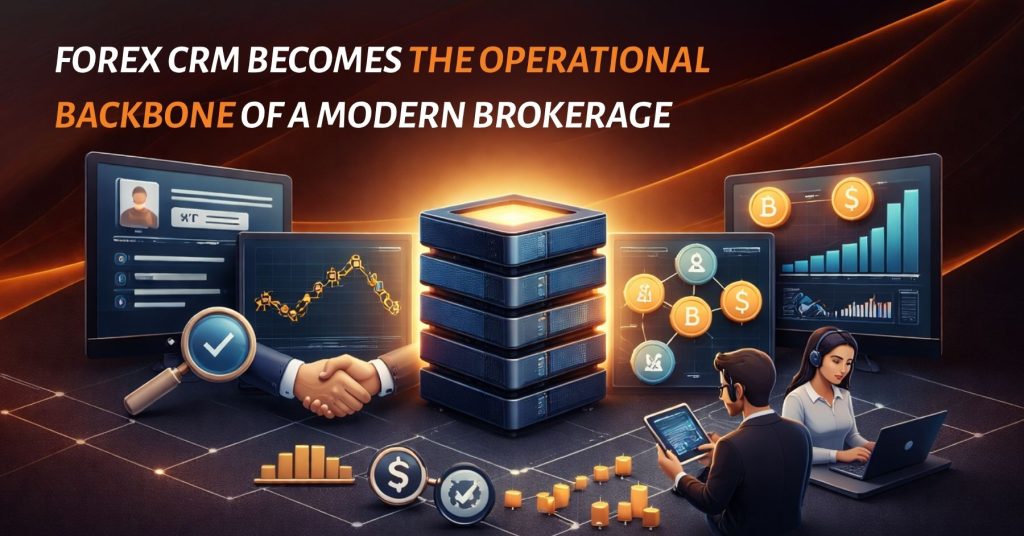
VAST CRM is designed with this philosophy in mind. Instead of separating trader and partner access into different interfaces, the platform combines both into a single client-facing portal, while maintaining strict role-based permissions in the background. This approach simplifies navigation for users who may act as both traders and introducing brokers, while also reducing development complexity and support overhead for the brokerage.
Admin Portal: The Admin Portal functions as the command center of the brokerage, giving internal teams full visibility and authority over platform activity. Through a single dashboard, administrators can:
Trader/IB Portal: For users, VAST CRM provides an IB portal that supports both trading account management and referral tracking. This unified design is particularly useful in the forex industry, where many traders also act as introducing brokers or affiliate partners. The definition of IB from a compliance-focused source adds credibility and clarifies the IB model. Within this combined portal, users can:
By merging trader and IB functionality into one streamlined interface, the platform reduces user confusion, eliminates the need for multiple logins, and provides a more cohesive experience for clients who participate in both trading and partner programs. The portal also integrates payment gateways, which act as intermediaries between traders and financial institutions, as outlined in how payment gateways work in forex trading.
A comparison illustrates how centralized infrastructure improves efficiency across departments:
| Operational Area | Traditional Brokerage | With VAST CRM |
| Client Onboarding | Manual document review, delayed account approvals | Automated KYC, instant account activation |
| Data Management | Information spread across multiple disconnected systems | Unified real-time database accessible by all departments |
| Partner/IB Commissions | Calculated manually or using spreadsheets | Automated multi-tier commission engine |
| Financial Reconciliation | Manual cross-checking of trading and financial records | Real-time synchronized balances and transactions |
| Reporting & Analytics | Time-consuming, often outdated reports | Instant analytics dashboards with exportable reports |
| Compliance & Audits | Manual tracking, high risk of errors | Automated logs, audit-ready, and regulatory compliance |
| Client Support | Slow response due to fragmented data | Faster response with centralized, up-to-date information |
| Trading Synchronization | Manual updates and reconciliations needed | Live trading data integration with MT5, Vertex FX, Match-Trader |
| Partner & Trader Interface | Separate portals for traders and IBs, confusing workflow | Unified portal for traders and IBs with role-based access |
This transition from manual to automated workflows directly impacts cost efficiency and scalability.
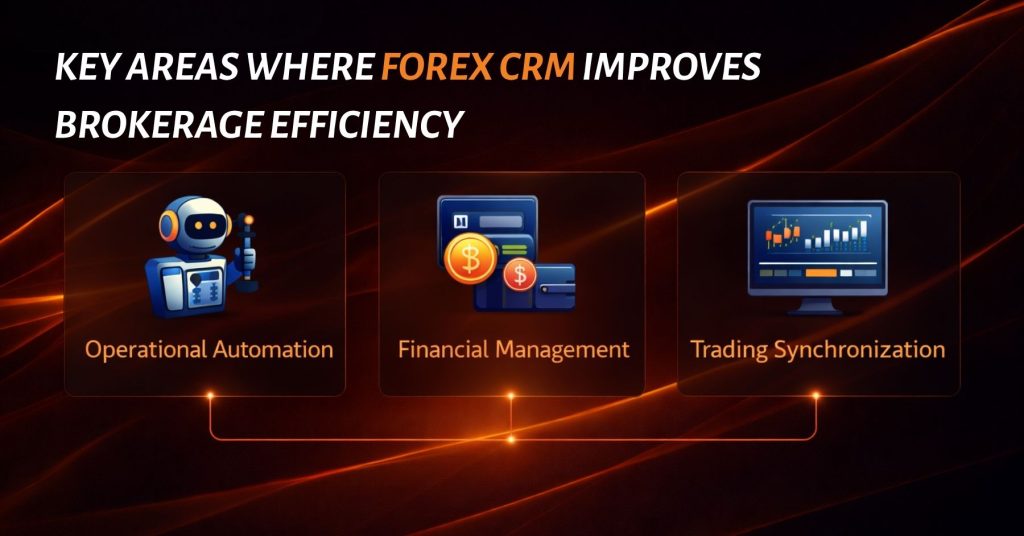
As forex brokerages grow, managing operations across multiple systems becomes complex and inefficient. A modern Forex CRM like VAST CRM centralizes client management, trading data, payments, and partner networks into one integrated platform, ensuring real-time data consistency and reduced manual work.
Keeping operational, financial, and trading data always aligned. This integrated design helps brokerages avoid discrepancies, improve reporting accuracy, and make faster business decisions based on reliable information.
While Forex CRM systems are often implemented to streamline internal operations, their impact extends far beyond back-office efficiency. When brokerage processes become faster and more structured, traders, partners, and compliance teams all benefit from smoother workflows and greater transparency.
Faster Onboarding & Better Trader Experience: Automated onboarding allows traders to complete KYC and activate accounts within minutes, improving conversions and first impressions.
Back-Office Automation: Automation of reports, reconciliation, and commission calculations reduces errors and frees teams to focus on growth and client engagement.
Transparent Partner & IB Management: Enables efficient partner operations through automated referral tracking, multi-level commission structures, real-time performance dashboards, and clear, auditable payouts—building trust and strengthening long-term partner relationships.
Built-In Compliance & Data Security: Secure document storage, activity logs, and automated reports help brokerages stay audit-ready while reducing compliance workload.
Data-Driven Decision Making: Real-time analytics provide insights into trader behavior, deposits, and partner performance, enabling smarter strategies and faster business decisions.
As the forex industry evolves, traders are no longer looking only for self-directed trading accounts. Many now prefer diversified participation through managed portfolios, copy trading, and community-driven strategies. To meet these expectations, modern brokerage platforms must extend beyond core CRM functionality and provide integrated investment tools that support both active traders and passive investors.
VAST CRM addresses this shift by embedding advanced investment modules directly into its ecosystem, eliminating the need for separate third-party social trading platforms. This allows brokerages to offer a wider range of services while maintaining full control over client data, performance tracking, and revenue streams.
Key integrated features include:
By offering these investment and social trading tools within the same CRM framework, brokerages can attract a broader client base—from hands-on traders to passive investors—while simplifying platform management and avoiding the integration challenges associated with external solutions.
As the forex market continues to evolve in 2026, brokerages are operating in an increasingly complex environment shaped by stricter regulations, rising trader expectations, and the need for real-time data visibility. Managing client onboarding, trading activity, payments, compliance, and partner networks through disconnected systems is no longer sustainable for firms aiming to scale efficiently and remain competitive.
Modern Forex CRM platforms are transforming brokerage operations and VAST CRM has been developed specifically to address these challenges by consolidating every critical operational layer into a single, unified ecosystem. Solutions like Finovex Forex CRM, B2B Broker, and Leverate’s Forex CRM platform illustrate how brokers manage client onboarding, KYC compliance, trading accounts, and partner programs from a centralized back-office environment.
From automated KYC verification and synchronized trading data to transparent IB commission tracking and integrated social trading modules, a centralized CRM eliminates inefficiencies while improving both internal productivity and client experience. As explained by TechTarget, customer relationship management systems enable organizations to manage customer interactions, automate processes, and maintain consistent data across departments.
By adopting a structured and automated brokerage management system, firms gain faster decision-making capabilities and stronger regulatory readiness aligned with international standards established by organizations such as the Financial Conduct Authority and the Financial Action Task Force.
In an industry where speed, transparency, and reliability define success, implementing a powerful Forex CRM is no longer just a technological upgrade—it has become a strategic necessity for brokerages looking to expand and thrive in the competitive global trading landscape. Brokerages that invest in forex CRM software development and deploy solutions like VAST CRM are better positioned to automate operations, maintain compliance, and scale their global client base efficiently.
Website: www.vastcrm.com
Phone: +91 9073331837 / +91 8100009773
Email: [email protected]
Vast CRM is committed to ensuring a smooth and successful experience. Reach out anytime—we are here to make sure you feel confident and secure in your journey with us.